As a child I was impressed by the bellows camera my father had. It used 120 medium format film and I still cherish the large square negatives that it produced. They captured the early years of my childhood, so my youth memories are in black&white. When I was in secondary school I found a Chinon rangefinder camera at a flea market in Delft and took it everywhere to take colour film pictures. When I was in college in the Dutch town of Leiden I first bought a point and shoot zoom camera that was not too bad, but the parallax between the finder and the result annoyed me. When my younger brother showed me his first Pentax SLR I quickly became fascinated by SLR cameras and started seriously shooting on 35 mm film. I got my hands on a half automatic Pentax as well, I think it was an MV and my brother Paul was so kind to give me two amazing lenses (SMC Pentax-K 1:1.4 50mm and SMC Pentax-M 1:2 35mm- it wasn't until much later that I realized how good they really are!) when he himself changed brands, and started making street pictures and photographs of the amateur and first professional musical gigs that I started to get. These gigs led me to exotic locations and I started to record the images that fascinated me. Because these projects followed one after another, I thought it was a good and interesting way to freeze at least some of the impressions I saw and was afraid I might forget. On some of these locations, e.g. Japan, I found old lenses that I could use on my camera, such as the amazing SMC Pentax-K 1:1,2 50mm lens that I still use and love to this day. I found it in a camera shop in Nagoya, which seemed like heaven to me: 7 floors of camera gear, among which one completely filled with used cameras and lenses! Over the years, my collection of lenses expanded slowly. I replaced the half automatic body for 2 fully automatic Super A Bodies, one for colour film and one for black and white. I had the colour film developed and was lucky to be initiated in the world of B&W developing and printing by my older brother Mario Bentvelsen (https://www.flickr.com/photos/mariobentvelsen/ ). My aforementioned younger brother Paul is also an avid and resourceful photographer. We get together with the brothers at least once a year for a shared photo hike.
I started to do a lot of printing in my home dark room in the Hague and in a photography club in Amsterdam. I had two enlargers, one for the 35 mm negative format and one for the 120 format square negatives, since an esteemed colleague at the Netherlands' Chamber Choir Michiel ten Houten de Lange gave me his old Yashica - A tlr-camera (picture in banner: thanks and all credit to Steve Carulli, for his beautiful review of this camera: https://casualphotophile.com/2021/01/29/yashica-a-review/ ). When everybody around me was making his or her first steps into digital photography I went back in time with that twin lens retro style film camera with the square image format and loved it. When my brand Pentax introduced the K-10 APS-c DSLR that promised to be compatible with all earlier generations of Pentax lenses, I made the switch to digital, and as much as I love working in Photoshop and Lightroom, the magic of seeing an image looming up in the developer fluid has always kept that feeling of wonder to me. The toxic chemicals, however, I do not miss too much. Indeed, I could use my older lenses, but since many were produced in the film era and the sensors of the first digital cameras were smaller than the original negative sizes the lenses were designed for, there was a 1.5 crop factor to be reckoned with. It resulted in an extension of my tele-reach and a limitation to my wide-angle reach. I owned a few other models of Pentax digital DSLR bodies, the K-7, which I used for a long time, although I was not satisfied because of the noise the sensor produced from 800 ISO and up, and the K-3 which I absolutely adored, during the short period I possessed it. That camera's motherboard died on me just outside the standard warranty period, and since my means were limited, I was forced to resort to the sturdy but noisy K-7 again.
In 2016 the full frame Ricoh Pentax K-1 came out, but I couldn't afford it, so it took me all the time until the next version, the K-1 mk II, came out before I was able to acquire it. I was in heaven. Suddenly my collection of old lenses made so much more sense again, and I could enjoy the whole reach of each lens, with the bokeh that comes with it, instead of just the middle of the lens, as is the case when you use an FF lens on an Aps-c body. My journey had entered a new phase, and I was lucky to acquire some amazing lenses such as the SMC-F 50 mm F1.4 with its amazing bokeh and the incredible HD Pentax-D FA 15-30mm F2.8 ED SDM WR, with it sharpness, beautiful colour rendering, weather resistant sealing and short minimal focusing distance.
The latter brings me to a next step in my photography: MFD photography, not macro but a way to bring out the best bokeh in the out of focus areas with lenses that allow to focus closely, some even down to 18 cms. This is a feature that I found in many older, manual focus lenses, and, as I could not always afford the latest, state of the art lenses, this quality was provided in a huge corpus of older lenses with the once widely shared M42 screw mount, that in its entirety became accessible through a small marvel, the M42 >PK adapter ring. If it hadn't been for photographer and musical colleague Petra Nuria Nieuwburg (https://photo.petranuria.com/), I might not have gotten the idea to check out a new generation of after market brands such as Samyang, Meike, TTartisans and the like. She opened my eyes to them in a chat about photography and gear, after which I found the wonderful Samyang 85 mm F1.4 to be to be an accurate but artistic asset that completely changed the playing field.
After that, I opened my eyes to m42 lenses, found out all about legendary names as Carl Zeiss Jena, Meyer Optik Görlitz, Yashica and Helios and many more, and went on a bargain hunt where and whenever I was on tour singing. So I was able to build a considerable collection of lenses for a modest amount. Also there were friends, like singer Hugo Naessens, who would donate their late father's collection of lenses and gear. I am always open to adopt homeless and lonely lenses and give them some love and attention and put them to good use again! I started to try and open up some budget lenses that had problems such as fungus, floating elements, balsam separation, dust and oily aperture blades, and learnt from the cheap lenses and Youtube tutorials. Now I am confident to take on some more valuable lenses, as long as they are mechanic and not electronically powered.
As much as this is a rather technical, gear related story, it is still a means to an end. As they say, "there are no bad lenses, only bad photographers." Check out my next page to find out my mission statement.
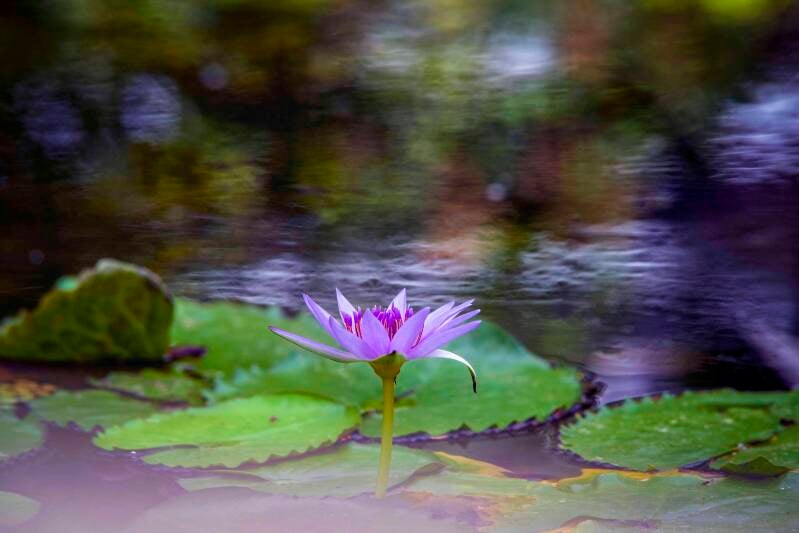
An example of MFD (minimal focusing distance) photography: zooming or approaching the subject until minimal focusing distance, then opening up the aperture in order to paint an impressionist blur in the background. Leipzig, botanical gardens 2021. Ricoh Pentax K-1 mk ii and Tamron SP AF 70-200mm F2.8 Di LD [IF] Macro at 200mm.